
RS03 · Road Safety
Driver Training Cabin
Can we train and assess the driver safely before exposing them to the real operating environment?
Training + assessment in simulation, from passenger car to heavy and mining-vehicle experiences.
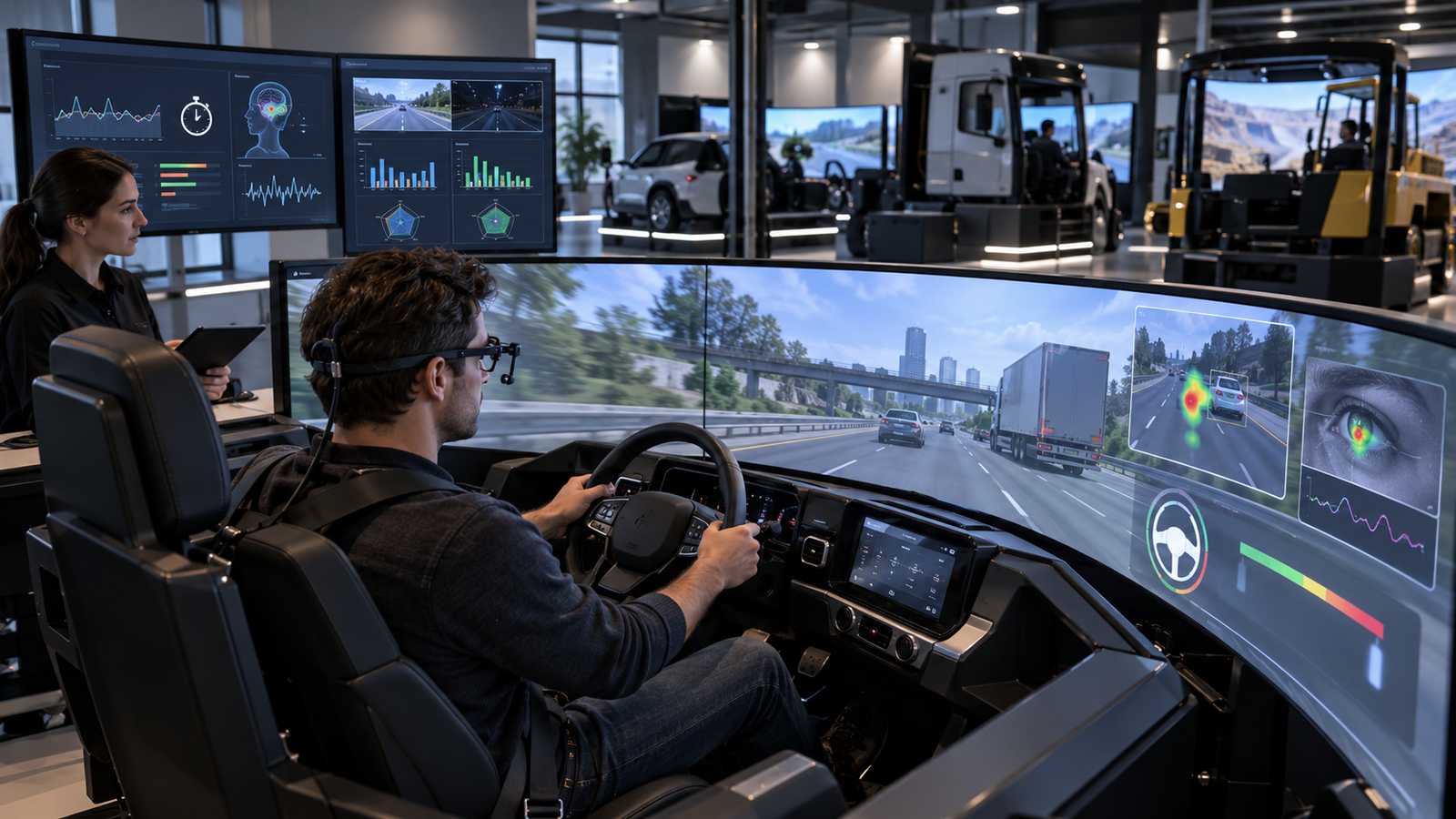
Training + assessment in simulation, from passenger car to heavy and mining-vehicle experiences.Driver Training Cabin
Can we train and assess the driver safely before exposing them to the real operating environment?
Road SafetyDriving simulator / training cabinEye Tracking GlassesEEGDriverSimulator
FIELDRoad Safety
EXECUTIONIn-person execution
TECHNOLOGY PATHDriving simulator / training cabin · Eye Tracking Glasses · EEG
STUDY CODERS03
The research question
Can we train and assess the driver safely before exposing them to the real operating environment?
Driver Training Cabin is a simulation-only service that combines driver training and objective assessment. Service level increases through two dimensions: the measurement technology used and the sophistication / realism of the vehicle mock-up and simulation experience, starting with passenger-car configurations and scaling to heavy-transport and mining-vehicle cabins.
Simulation onlyPassenger-car simulatorHeavy-vehicle simulatorMining-vehicle / mining-equipment simulator
Technology configuration
Measurement follows the task
The technology path shown here is the approved structure for this service. The exact protocol is configured around the research question, environment and participant flow.
Vehicle-specific mock-up and simulation experience configured to the training objective.
Synchronized simulation, visual-attention and neurophysiological measurement during the same driving scenarios.
Typical protocol · Road Safety
How this study is executed.
The protocol below reflects the service definition developed for Neuro Garage. Final details are confirmed before execution.
Define the vehicle type, simulation fidelity, driver profile and critical scenarios to be trained and assessed.
Run a pre-training simulation to establish the driver baseline.
Expose the driver to programmed critical situations such as unexpected pedestrians, emergency braking, road obstacles, lane intrusion, low visibility and other context-specific risk events.
When advanced measurement is selected, synchronize Eye Tracking Glasses and EEG with simulator events to evaluate attention, reaction, fatigue, drowsiness, alertness and cognitive effort.
Deliver the training sequence and repeat the relevant scenarios under the post-training condition.
Compare pre-training vs. post-training performance and generate an individual driver profile with targeted training recommendations.
Typical outputs
What this specific study can produce
01Individual driver profile
02Strengths and weaknesses
03Critical errors
04Non-critical errors
05Reaction times
06Visual-attention sequence
07Ignored elements
08Response to critical events
09Fatigue indicators
10Drowsiness indicators
11Alertness level
12Cognitive load / mental effort when applicable
13Pre-training vs. post-training comparison
14Driver-specific training recommendations
Decisions supported
What the client can change with the evidence
The study is designed to translate observed behavior into concrete operational, people, design or risk-management decisions.
Industry references / comparable applications
Who has used comparable research approaches?
Publicly documented examples from companies and institutions worldwide. These organizations are not presented as Neuro Garage clients, and the examples do not imply they purchased this exact Neuro Garage protocol.
01


SEATPublic precedent
Driver-attention and road-safety research using eye tracking to understand gaze allocation in driving.
View public source ↗02MIT AgeLabPublic precedent
Automotive human-factors research on driver attention and interaction.
View public source ↗03Toyota CanadaPublic precedent
Real-world customer-journey research with wearable eye tracking; relevant to applied automotive behavior studies.
View public source ↗Scientific configuration
The method follows the question
Technology is selected because it is scientifically appropriate for the research objective, not because a device must be used. Santiago configures the study scope, stimuli, participant flow and measurement path before execution.
Discuss this study