
POL03 · Political Marketing
Printed Material Tester
Which printed piece attracts more attention and makes the campaign message easier to see, understand and remember?
Research protocolPrinted Material Tester
Which printed piece attracts more attention and makes the campaign message easier to see, understand and remember?
Political MarketingOnline Eye TrackingEye Tracking BarPrinted MaterialPoliticalPoster
FIELDPolitical Marketing
EXECUTIONOnline or in-person execution
TECHNOLOGY PATHOnline Eye Tracking · Eye Tracking Bar
STUDY CODEPOL03
The research question
Which printed piece attracts more attention and makes the campaign message easier to see, understand and remember?
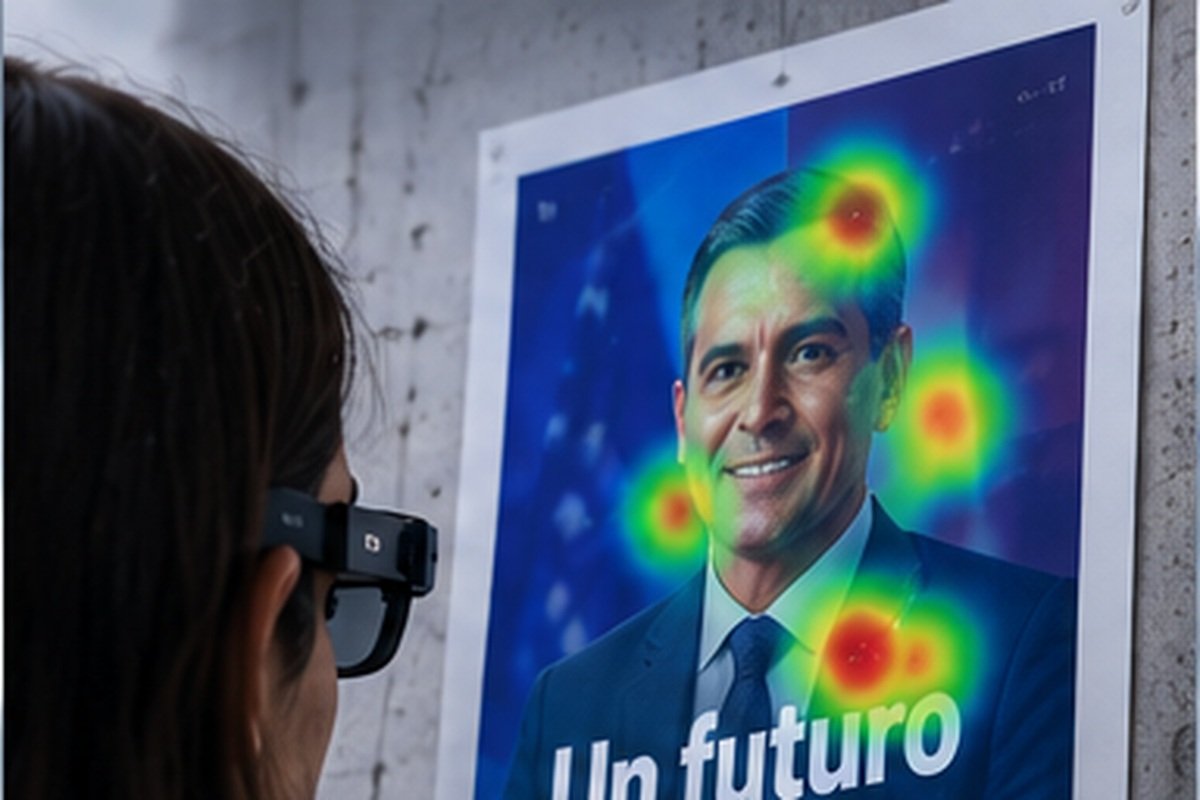
Printed Material Tester evaluates posters, flyers, brochures and other political printed pieces to determine how attention is distributed, which elements are found first, and which candidate, slogan, message, symbol or call-to-action elements are overlooked.
Online image-based evaluationControlled in-person desktop evaluation
Technology configuration
Measurement follows the task
The technology path shown here is the approved structure for this service. The exact protocol is configured around the research question, environment and participant flow.
Typical protocol · Political Marketing
How this study is executed.
The protocol below reflects the service definition developed for Neuro Garage. Final details are confirmed before execution.
Define the printed pieces, comparison set and critical visual elements.
Present the approved materials through Online Eye Tracking or Eye Tracking Bar.
Measure first fixation, fixation count / duration, total viewing time, visual sequence and attention distribution.
Identify candidate, slogan, message, symbol and CTA visibility together with ignored elements and blind spots.
Report the observed visual-performance differences between pieces.
Typical outputs
What this specific study can produce
01Heatmap
02Gaze Plot
03Areas of Interest Performance
04Time to First Fixation
05Fixation Count
06Fixation Duration
07Total Viewing Time
08Visual Sequence
09Attention Distribution
10Candidate Visibility
11Slogan Visibility
12Political Symbol Visibility
13Message Visibility
14CTA Visibility
15Ignored Elements
16Visual Blind Spots
17Version Comparison
Decisions supported
What the client can change with the evidence
The study is designed to translate observed behavior into concrete operational, people, design or risk-management decisions.
Industry references / comparable applications
Who has used comparable research approaches?
Publicly documented examples from companies and institutions worldwide. These organizations are not presented as Neuro Garage clients, and the examples do not imply they purchased this exact Neuro Garage protocol.
01
OA
Operate A/SPublic precedent
Copenhagen PR bureau evaluated election posters with eye tracking, facial-expression analysis and GSR.
View public source ↗02G
GooglePublic precedent
Publicly documented advertising-attention research using eye tracking; comparable methodology for creative testing, though not a political campaign study.
View public source ↗03M/
Meta / FacebookPublic precedent
Publicly documented TV-advertising eye-tracking research; comparable ad-attention methodology, not evidence of a political-campaign engagement.
View public source ↗Scientific configuration
The method follows the question
Technology is selected because it is scientifically appropriate for the research objective, not because a device must be used. Santiago configures the study scope, stimuli, participant flow and measurement path before execution.
Discuss this study