
APPLICATIONSMilitary Industry
NEURO GARAGE · SCIENTIFIC SERVICE · MI03Military Skills Transfer
Can the expertise of a military specialist be made visible and transferred to learners?
Capture expert strategy. Train it. Measure whether it transfers.
Every protocol is configured to the objective, sample and measurement environment.
Capture expert strategy. Train it. Measure whether it transfers.Military Skills Transfer
Can the expertise of a military specialist be made visible and transferred to learners?
Military IndustryEye Tracking GlassesEye Tracking VREEG optional for learnersMilitarySkills Transfer
RESEARCH APPLICATIONMilitary Industry
FIELDMilitary Industry
EXECUTIONIn-person execution
TECHNOLOGY PATHEye Tracking Glasses · Eye Tracking VR · EEG optional for learners
STUDY CODEMI03
THE VALUE OF THE STUDY
From a research question to actionable evidence.
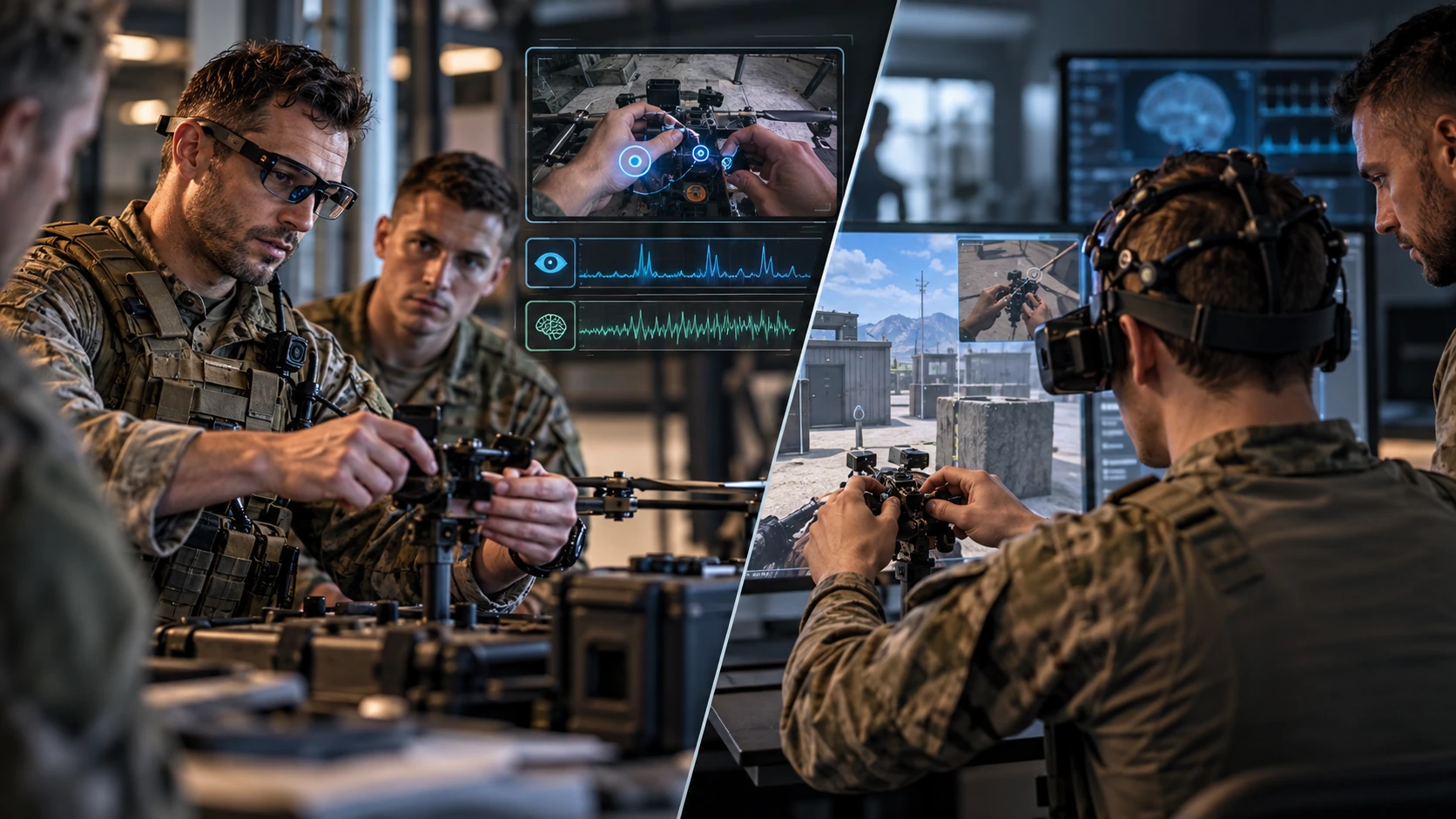
Military Skills Transfer captures the observable strategy of an expert and uses it as the basis for structured learner training. The service itself is the transfer process: expert execution is measured first, learners reproduce the task, and pre/post performance is compared to quantify how the expert strategy is being acquired.
Objective measurementProtocol-defined interpretationDecision-oriented reporting
01 / Scientific objective
Can the expertise of a military specialist be made visible and transferred to learners?
Military Skills Transfer captures the observable strategy of an expert and uses it as the basis for structured learner training. The service itself is the transfer process: expert execution is measured first, learners reproduce the task, and pre/post performance is compared to quantify how the expert strategy is being acquired.
Real operational taskTechnical taskTactical taskMaintenance taskSimulatorVR
02 / Technology configuration
Measurement follows the task
The technology path shown here is the approved structure for this service. The exact protocol is configured around the research question, environment and participant flow.
Captures the expert visual strategy, priorities, sequence and critical cues.
Technology follows whether the learner performs the task in the real / simulator environment or VR.
Added when the approved learner protocol requires neurophysiological measurement.
03 / Typical protocol · Military Industry
How this study is executed.
The protocol below reflects the service definition developed for Neuro Garage. Final details are confirmed before execution.
Capture the expert performing the target task and identify critical visual cues, sequence, priorities and decision points.
Establish the expert performance pattern to be transferred.
Measure learner baseline performance before training.
Train learners using the expert-derived strategy and task structure.
Re-evaluate learner performance after training and compare it with both baseline and the expert pattern.
05 / Expected study outputs
What the research delivers
01Expert visual sequence
02Expert priorities
03Critical cues / points
04Learner errors
05Learner deviations from expert pattern
06Pre-training performance
07Post-training performance
08Learning curve
09Similarity-to-expert pattern
10Remaining skill gaps
SCIENTIFIC EVIDENCE
Observe. Measure. Decide.
The deliverables depend on the approved study protocol. The examples below are categories of outputs and potential decisions, not fabricated participant data or promised findings.
Appropriate instrumentation
Eye Tracking Glasses
Eye Tracking VR
EEG optional for learners
Protocol-based metrics
Expert visual sequence
Expert priorities
Critical cues / points
Decisions supported
Transfer tacit expertise
Accelerate learning
Preserve critical know-how
Measurement outputs and interpretation must follow data-quality checks and the actual scientific protocol. No sample findings are represented here.
Decisions supported
What the client can change with the evidence
The study is designed to translate observed behavior into concrete operational, people, design or risk-management decisions.
Industry references / comparable applications
Who has used comparable research approaches?
Publicly documented examples from companies and institutions worldwide. These organizations are not presented as Neuro Garage clients, and the examples do not imply they purchased this exact Neuro Garage protocol.
01


Tongji UniversityPublic precedent
Eye-tracking classroom used in applied learning and human-centered design research.
View public source ↗02Peking UniversityPublic precedent
Eye-tracking classroom program used in teaching and student research.
View public source ↗03Slovak University of TechnologyPublic precedent
Eye-tracking classroom and lab used to study e-learning and human-computer interaction.
View public source ↗NEXT STEP
Define the right study, not just the equipment.
Tell us your research question. We will discuss the sample, measurement setting, technologies and reporting requirements before confirming the scope.
SCIENTIFIC SERVICEMilitary Skills Transfer
Request proposal