
APPLICATIONSHealth
NEURO GARAGE · SCIENTIFIC SERVICE · H31Tension-Type Headache EMG Assessment & Biofeedback
What muscle-tension pattern is present at rest and during relevant tasks, and can the patient learn to reduce it?
Every protocol is configured to the objective, sample and measurement environment.
Research protocolTension-Type Headache EMG Assessment & Biofeedback
What muscle-tension pattern is present at rest and during relevant tasks, and can the patient learn to reduce it?
HealthSurface EMGHealthTensionType
RESEARCH APPLICATIONHealth
Health pathways are in-person and AD HOC. Every case is subject to clinical/scientific gating and jurisdiction-specific review. Neuro Garage measurements complement — and do not replace — licensed medical judgement, diagnosis or standard care.
FIELDHealth
EXECUTIONAD HOC · in-person scientific protocol
TECHNOLOGY PATHSurface EMG
STUDY CODEH31
THE VALUE OF THE STUDY
From a research question to actionable evidence.
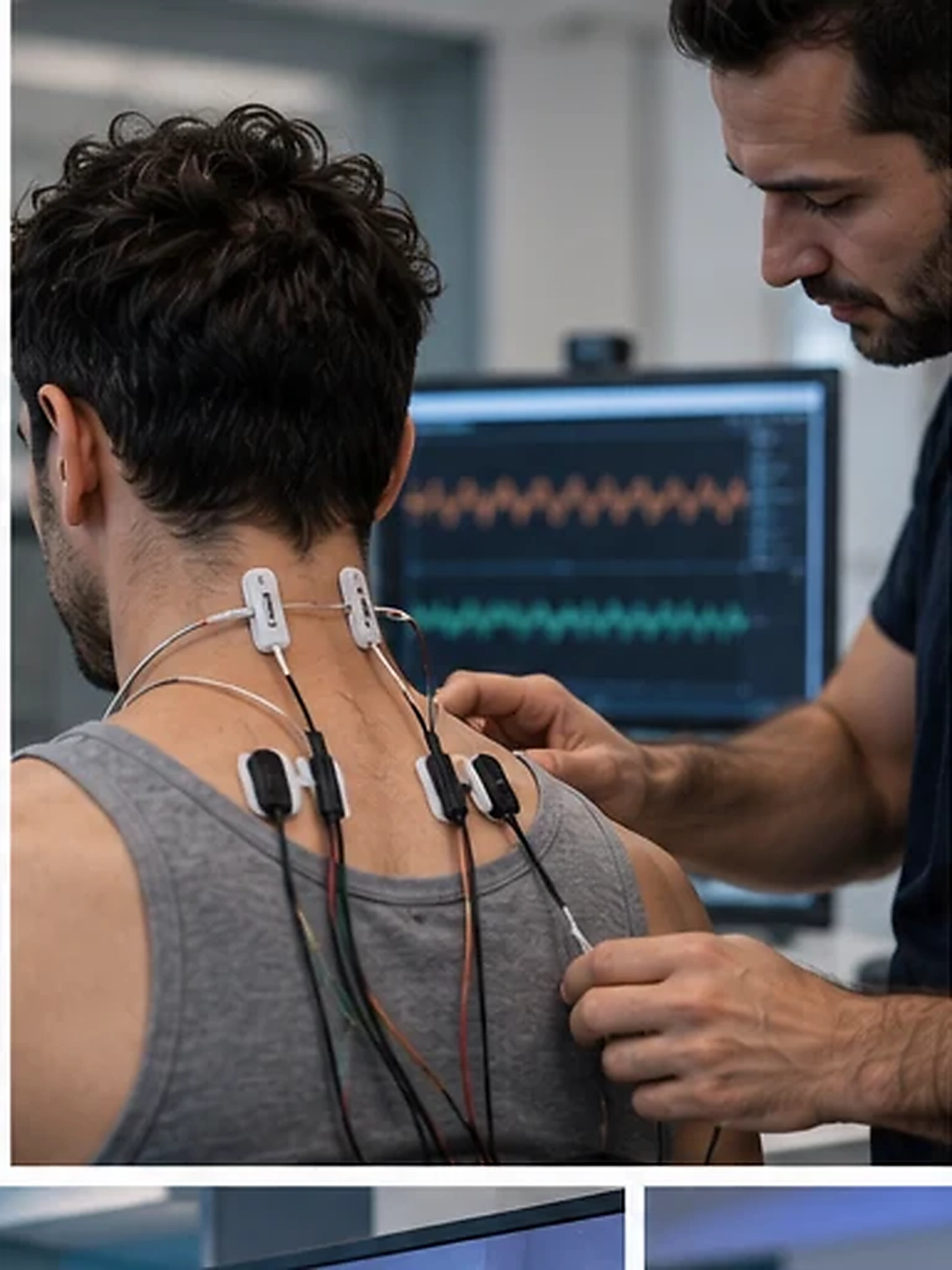
A focused surface-EMG service for tension-type headache, quantifying relevant muscle activation and training voluntary down-regulation through biofeedback.
Objective measurementProtocol-defined interpretationDecision-oriented reporting
01 / Scientific objective
What muscle-tension pattern is present at rest and during relevant tasks, and can the patient learn to reduce it?
A focused surface-EMG service for tension-type headache, quantifying relevant muscle activation and training voluntary down-regulation through biofeedback.
Clinical EMG / biofeedback room
02 / Technology configuration
Measurement follows the task
The technology path shown here is the approved structure for this service. The exact protocol is configured around the research question, environment and participant flow.
Rest, task activation and real-time biofeedback.
03 / Typical protocol · Health
How this study is executed.
The protocol below reflects the service definition developed for Neuro Garage. Final details are confirmed before execution.
Select clinically relevant muscles.
Record resting EMG.
Run standardized cognitive/postural or symptom-relevant task.
Provide real-time EMG feedback and relaxation/regulation training.
Compare activation and learning across sessions.
05 / Expected study outputs
What the research delivers
01Headache Muscle-Tension Profile
02EMG Activation Profile
03Muscle Regulation Capacity
04Biofeedback Learning Curve
05Headache Intensity Evolution
SCIENTIFIC EVIDENCE
Observe. Measure. Decide.
The deliverables depend on the approved study protocol. The examples below are categories of outputs and potential decisions, not fabricated participant data or promised findings.
Appropriate instrumentation
Surface EMG
Protocol-based metrics
Headache Muscle-Tension Profile
EMG Activation Profile
Muscle Regulation Capacity
Decisions supported
Target muscle-regulation training
Monitor learning
Support adjunctive headache management
Measurement outputs and interpretation must follow data-quality checks and the actual scientific protocol. No sample findings are represented here.
Decisions supported
What the client can change with the evidence
The study is designed to translate observed behavior into concrete operational, people, design or risk-management decisions.
Industry references / comparable applications
Who has used comparable research approaches?
Publicly documented examples from companies and institutions worldwide. These organizations are not presented as Neuro Garage clients, and the examples do not imply they purchased this exact Neuro Garage protocol.
01


German Heart Center BerlinPublic precedent
Eye tracking used to study cognition, training and attention in medical procedures.
View public source ↗02University of Massachusetts Amherst / Baystate Medical CenterPublic precedent
Wearable eye-tracking research on clinical-device usability and safety.
View public source ↗03Karolinska InstitutePublic precedent
Eye-movement research supporting healthcare and neurological investigations.
View public source ↗NEXT STEP
Define the right study, not just the equipment.
Tell us your research question. We will discuss the sample, measurement setting, technologies and reporting requirements before confirming the scope.
SCIENTIFIC SERVICETension-Type Headache EMG Assessment & Biofeedback
Request proposal