
CR03 · Criminology
Aggressor Detector & Trauma Response Assessment
Does one candidate trigger a differential recognition and trauma-linked response in the victim or witness?
Candidate-by-candidate recognition and trauma-response research.
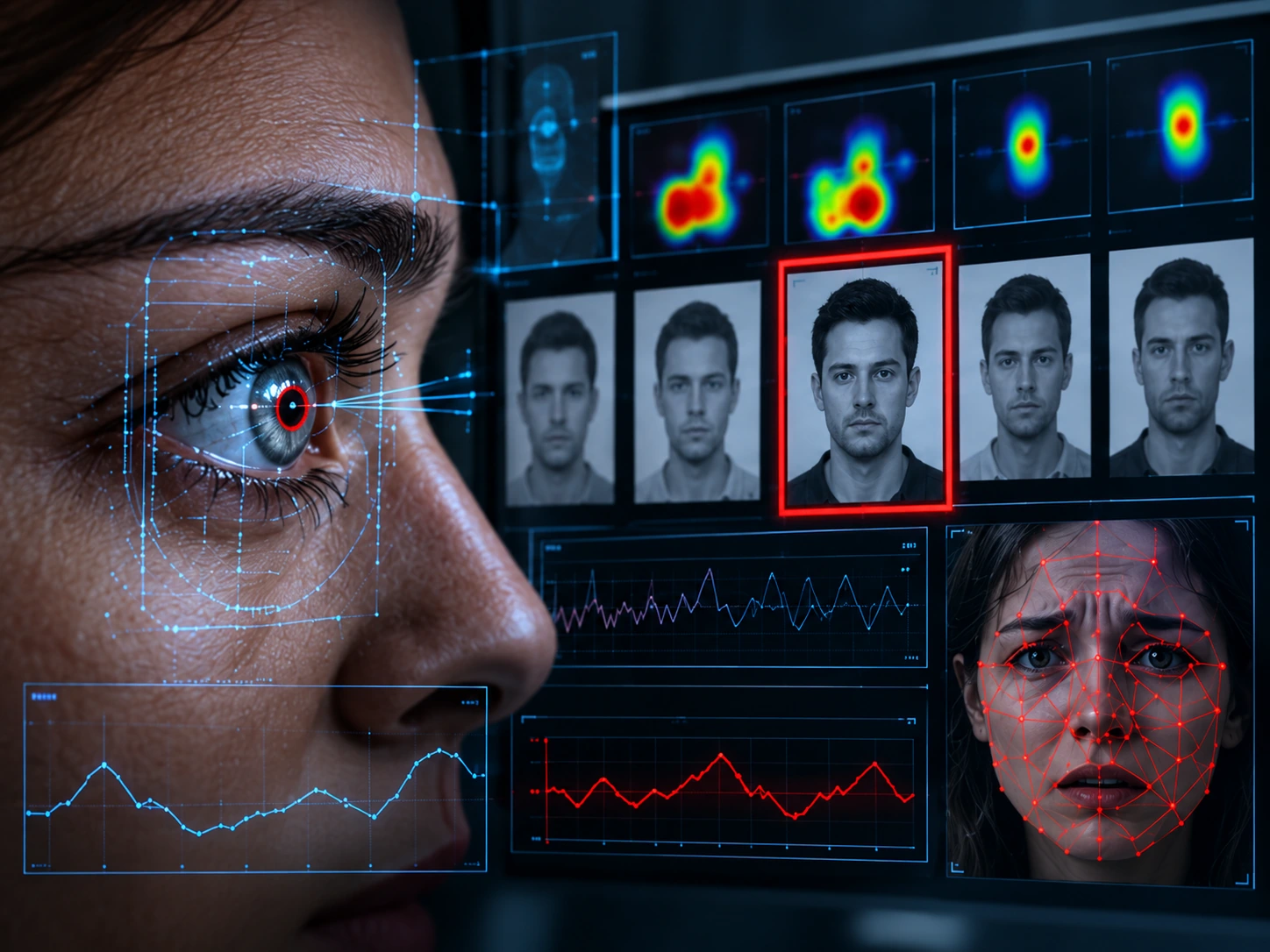
Candidate-by-candidate recognition and trauma-response research.Aggressor Detector & Trauma Response Assessment
Does one candidate trigger a differential recognition and trauma-linked response in the victim or witness?
CriminologyEye TrackingPupillometryFaceReaderAggressor DetectorVictim Recognition
FIELDCriminology
EXECUTIONAD HOC · in-person scientific protocol
TECHNOLOGY PATHEye Tracking · Pupillometry · FaceReader
STUDY CODECR03
The research question
Does one candidate trigger a differential recognition and trauma-linked response in the victim or witness?
Aggressor Detector & Trauma Response Assessment is an individual victim- or witness-recognition protocol that compares responses across multiple candidates. It combines Eye Tracking, pupillometry and facial-expression analysis to identify differential recognition, attention, avoidance and fear / threat-related responses. The output is an investigative signal for follow-up; it does not classify a candidate as the aggressor from a single physiological or facial response.
Controlled candidate-recognition sessionPhoto or video candidate lineupProtocol-defined investigative environment
Technology configuration
Measurement follows the task
The technology path shown here is the approved structure for this service. The exact protocol is configured around the research question, environment and participant flow.
Candidate-specific fixation, latency, revisits, avoidance / re-engagement and pupil-response dynamics.
Time-linked fear / threat, surprise, anger, disgust and other facial-response patterns.
Typical protocol · Criminology
How this study is executed.
The protocol below reflects the service definition developed for Neuro Garage. Final details are confirmed before execution.
Establish the legal / investigative question and construct the candidate set under an approved recognition procedure.
Standardize candidate presentation conditions such as size, lighting, background, exposure time and order to reduce presentation bias.
Record a baseline before candidate exposure.
Present candidates under a randomized or otherwise legally approved sequence while continuously recording gaze, pupil dynamics and facial response.
Measure candidate-specific fixation latency, dwell, revisits, avoidance / re-engagement, pupil dilation and facial fear / threat response.
Capture explicit recognition and confidence when the investigative protocol requires it.
Integrate the multimodal response into a candidate differential-response profile and issue an investigative follow-up alert when warranted.
Typical outputs
What this specific study can produce
01Aggressor Recognition Signal
02Trauma-Linked Response
03Pupillary Recognition Response
04Candidate Attention Profile
05Fear / Threat Facial Response
06Recognition–Avoidance Pattern
07Explicit Recognition & Confidence — when collected
08Candidate Differential Response
09Investigative Follow-up Alert
Decisions supported
What the client can change with the evidence
The study is designed to translate observed behavior into concrete operational, people, design or risk-management decisions.
Industry references / comparable applications
Who has used comparable research approaches?
Publicly documented examples from companies and institutions worldwide. These organizations are not presented as Neuro Garage clients, and the examples do not imply they purchased this exact Neuro Garage protocol.
01
NF
National Forensic Sciences UniversityPublic precedent
Peer-reviewed VR crime-scene research integrating eye tracking with forensic task exposure.
View public source ↗02AF
Authorized Firearms Officer researchPublic precedent
Published eye-tracking work comparing expert and novice visual behavior during simulated tactical scenarios.
View public source ↗03AS
Active-duty service-member researchPublic precedent
Published study of situational awareness in a complex virtual navigation task using eye tracking and EEG.
View public source ↗Scientific configuration
The method follows the question
Technology is selected because it is scientifically appropriate for the research objective, not because a device must be used. Santiago configures the study scope, stimuli, participant flow and measurement path before execution.
Discuss this study