
CR01 · Criminology
Neurocriminology Assessment
What neurocognitive, attentional and neurophysiological patterns characterize this criminological profile?
Individual neurocriminology research built around the investigative hypothesis.
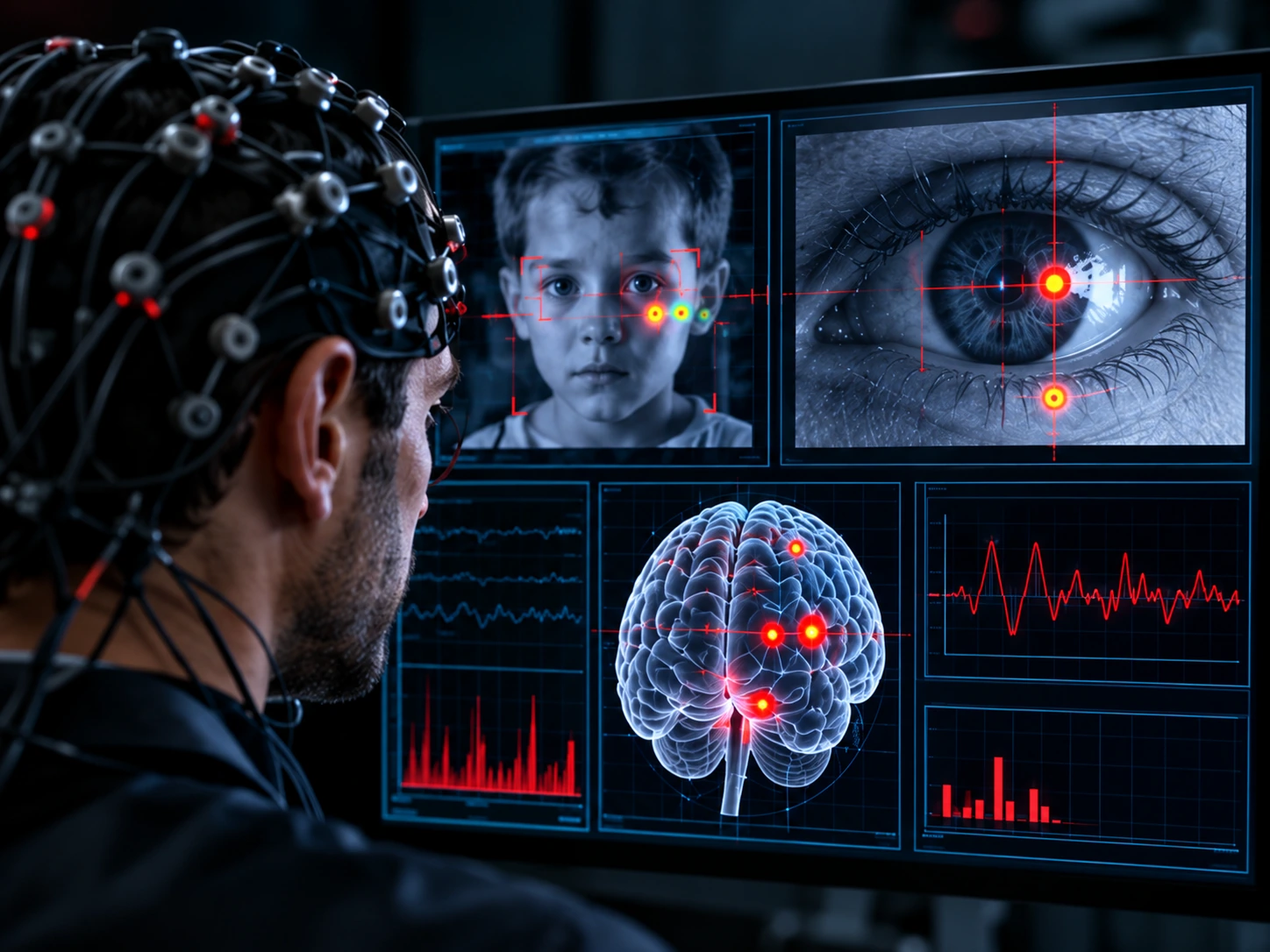
Individual neurocriminology research built around the investigative hypothesis.Neurocriminology Assessment
What neurocognitive, attentional and neurophysiological patterns characterize this criminological profile?
CriminologyEye TrackingEEGNeurocriminologyCriminologyInhibitory Control
FIELDCriminology
EXECUTIONAD HOC · in-person scientific protocol
TECHNOLOGY PATHEye Tracking · EEG
STUDY CODECR01
The research question
What neurocognitive, attentional and neurophysiological patterns characterize this criminological profile?
Neurocriminology Assessment is an individual, hypothesis-driven research protocol designed to identify and characterize neurocognitive, attentional, behavioral and neurophysiological patterns associated with a specific criminological question. Unlike standardized mass screening, each protocol is built for the person and case by a criminologist or intelligence specialist with medical assistance. Group packages can also be configured when the research requires profile comparison. Findings are interpreted as neurocriminological evidence within the study context and not as standalone proof of guilt.
Controlled neurocriminology assessmentForensic / investigative research environmentProtocol-defined in-person setting
Technology configuration
Measurement follows the task
The technology path shown here is the approved structure for this service. The exact protocol is configured around the research question, environment and participant flow.
Visual attention, gaze sequence, avoidance / re-engagement, pupillary and task-response patterns.
Adds synchronized neurophysiological dynamics during inhibitory-control, decision, attention and emotional-processing tasks.
Typical protocol · Criminology
How this study is executed.
The protocol below reflects the service definition developed for Neuro Garage. Final details are confirmed before execution.
Define the investigative hypothesis with a criminologist or intelligence specialist and medical assistance.
Select the cognitive, attentional, emotional and behavioral domains relevant to the case.
Configure protocol-defined tasks such as Go/No-Go, Stop-Signal, Stroop / Hayling, risk-reward, working-memory, cognitive-flexibility and emotional-attention paradigms.
When relevant and legally / ethically permitted, use lawful non-explicit visual stimuli to study differential atypical sexual-interest and visual-arousal indicators without inferring an offense from a single signal.
Record Eye Tracking and, in the advanced protocol, synchronized EEG across the task sequence.
Integrate inhibitory control, impulsivity, attention, decision-making, emotional / social processing, stimulus preference / avoidance and neurophysiological reactivity into the case-specific neurocriminological profile.
Generate a targeted follow-up alert when a pattern justifies a deeper specialized investigation.
Typical outputs
What this specific study can produce
01Neurocriminological Profile
02Inhibitory Control Index
03Impulsivity & Response Regulation Profile
04Executive Control Profile
05Decision-Making & Risk Processing
06Attention & Visual Strategy Profile
07Emotional / Social Processing Profile
08Atypical Sexual Interest Indicators — when protocol-relevant
09Stimulus Preference & Avoidance Pattern
10Neurophysiological Reactivity Profile
11Profile Similarity Analysis — when comparison groups are available
12Neurocriminological Alert
Decisions supported
What the client can change with the evidence
The study is designed to translate observed behavior into concrete operational, people, design or risk-management decisions.
Industry references / comparable applications
Who has used comparable research approaches?
Publicly documented examples from companies and institutions worldwide. These organizations are not presented as Neuro Garage clients, and the examples do not imply they purchased this exact Neuro Garage protocol.
01
NF
National Forensic Sciences UniversityPublic precedent
Peer-reviewed VR crime-scene research integrating eye tracking with forensic task exposure.
View public source ↗02AF
Authorized Firearms Officer researchPublic precedent
Published eye-tracking work comparing expert and novice visual behavior during simulated tactical scenarios.
View public source ↗03AS
Active-duty service-member researchPublic precedent
Published study of situational awareness in a complex virtual navigation task using eye tracking and EEG.
View public source ↗Scientific configuration
The method follows the question
Technology is selected because it is scientifically appropriate for the research objective, not because a device must be used. Santiago configures the study scope, stimuli, participant flow and measurement path before execution.
Discuss this study